


What is research data?
Research data refers to the materials generated or collected in the course of a research project. These may include facts, observations or experiences on which the argument, theory or evidence is based.
They also serve to validate the results of the research carried out and are recognised by the scientific community (Torres-Salinas et al., 2012)
Data includes: laboratory notebooks, field notebooks, primary research data, questionnaires, audio tapes, videos, model development, photographs, films, digital objects, algorithms, scripts, databases, metadata and metadata schemas, software configurations, and test checks and responses. (FECYT, 2012).
The following are not considered final research data: laboratory notes, partial datasets, preliminary analyses, draft papers, plans for future research, communications with colleagues, physical objects and laboratory specimens.
Types of data:
-
Data may be numerical, descriptive or visual
-
By nature: qualitative or quantitative
-
Depending on their level of processing: raw (primary data), processed or analysed.
-
Depending on their source, they may be experimental (e.g. chromatograms), observational (e.g. surveys) or computational (obtained through simulation).
-
Depending on their format: Textual (Word, PDF, RTF, etc.), Numerical (Excel, CSV, etc.), Multimedia (JPEG, MPEG, WAV, etc.), Structured (XML, MySQL, etc.), Software code (Java, C, etc.), Software-specific (Mesh, 3D CAD, statistical model, etc.), discipline- or instrument-specific.
What is research data management
Research Data Management (RDM) is present in all phases of research and encompasses the collection, organisation, documentation, storage and preservation of data used or generated during a research project.
Proper data management helps researchers conduct better research and involves:
-
Compliance with the requirements of funding bodies.
-
Greater transparency for the validation of research results.
-
Improved data protection and minimised risk of data loss.
-
Ensuring that data is findable, accessible, interoperable and reusable: FAIR data.
-
Saving time by avoiding duplication and making efficient use of available resources.
-
Enhance the researcher’s profile, as well as the impact and visibility of projects
Source: Pérez Allende, M.L. (2015) PAGODA Portal. Data Management Plan. Carlos III University of Madrid
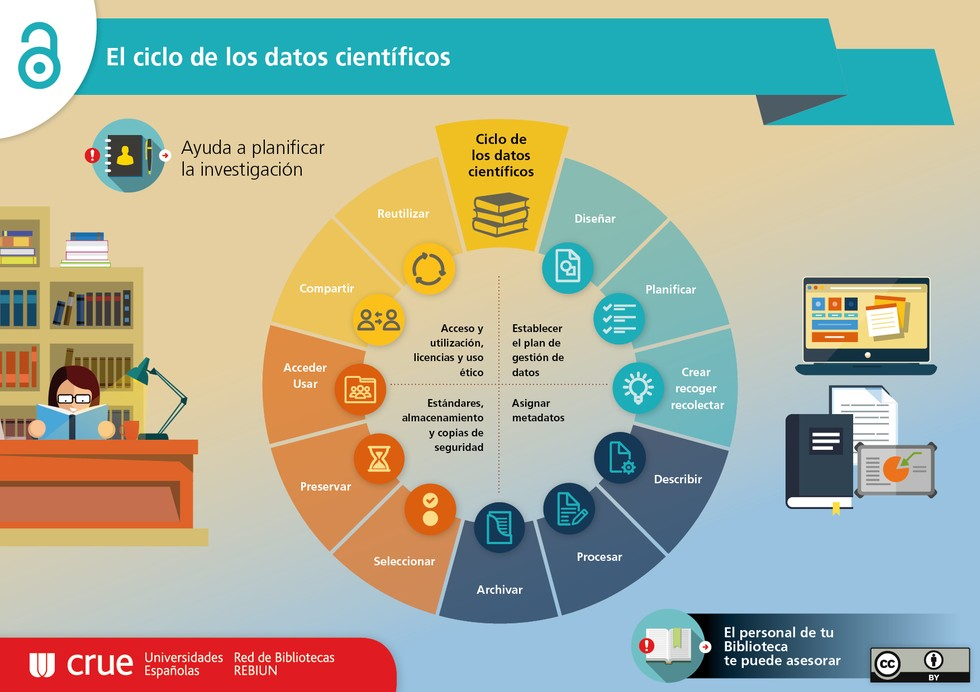
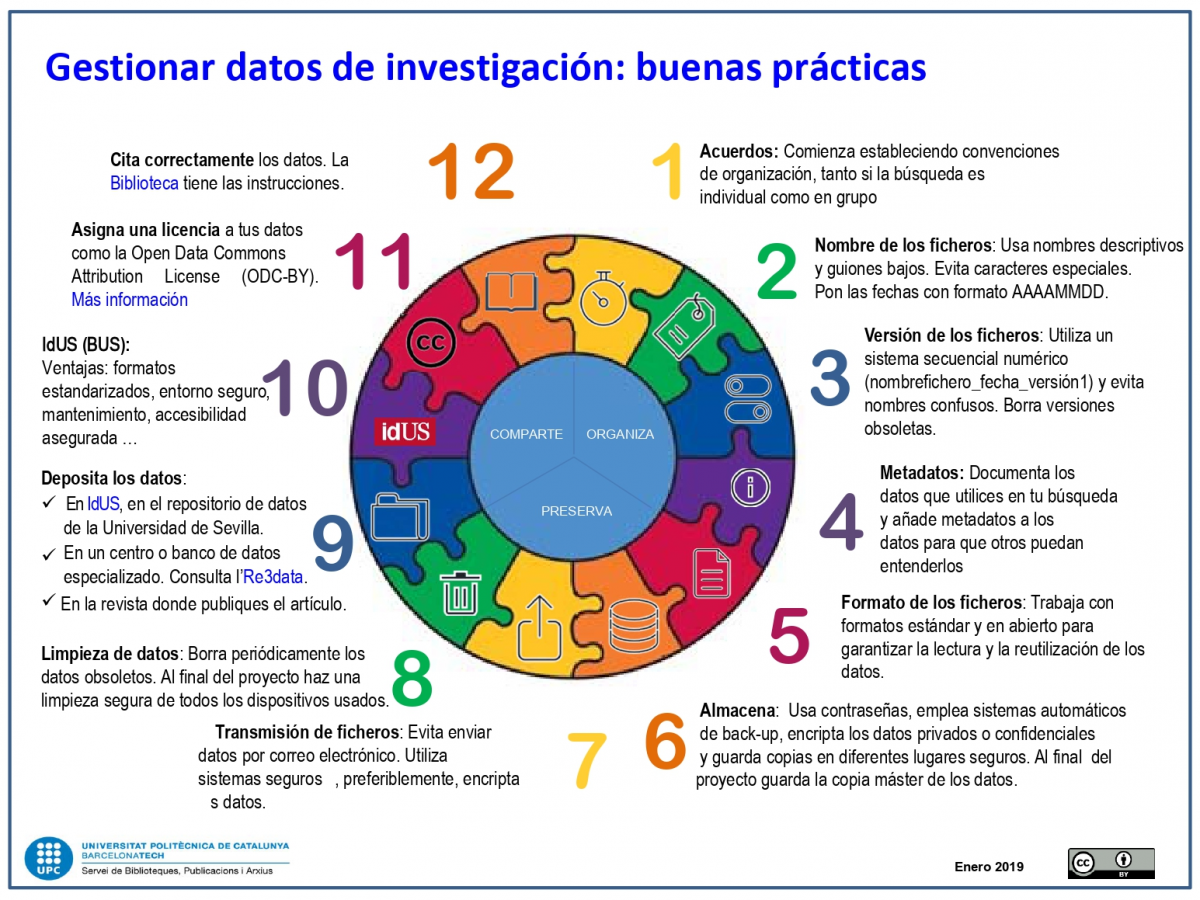
Sources: REBIUN and Infoguía on good practices in research data management (produced by the Library, Publications and Archives Service of the Polytechnic University of Catalonia and translated by the Information and Reference Section of the Library Service at the University of A Coruña)
Further information: MareData. Recommendations for research data management. Aimed at researchers. Dec. 2018